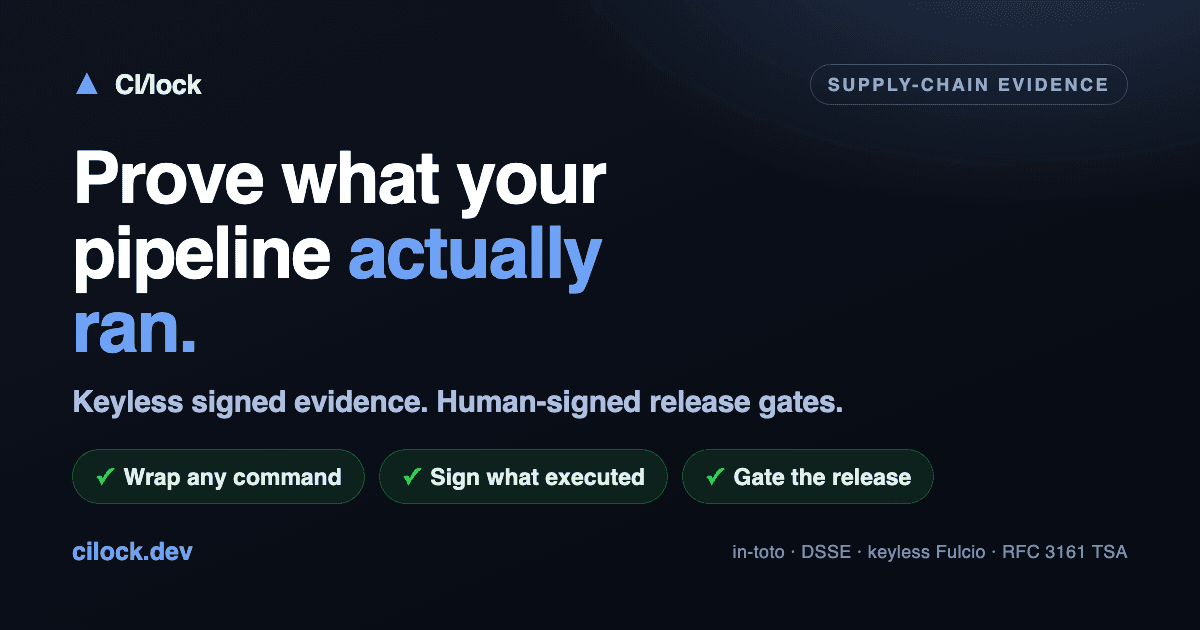
CI/Lock gives your software pipeline a tamper-proof receipt.
CI/Lock is the right tool if your team faces supply-chain security audits or government compliance mandates and is tired of reconstructing evidence manually. It solves a real, painful problem with strong open-standard credentials. Not useful if you're a small team without compliance obligations — the setup complexity outweighs the benefit.
Sign every CI/CD step with SLSA-aligned in-toto attestations from GitHub Actions and GitLab CI, verified against a Rego policy at release time
Wrap SAST, DAST, SBOM, and secret-scanner runs (OWASP ZAP, Trivy, Grype, Semgrep, Gitleaks) so auditors see signed proof they ran on the exact artifact
Capture runtime evidence — Falco events, Linkerd mTLS, kube-bench CIS benchmarks — and gate releases on cluster-integrity conditions, not just scanner results
Map attestations automatically to NIST 800-53, FedRAMP, and SOC 2 controls through the TestifySec Platform, eliminating manual evidence reconstruction
Control AI-agent-driven releases with cryptographic policy gates: the agent can produce evidence, but only a human-signed policy decides if the artifact ships
Source: CI/Lock·Verified July 2026
No integrations listed yet for CI/Lock.
Native Claude Code integration for release-gate checks. AI-agent governance model lets agents produce signed attestations while human-controlled cryptographic policies control what actually ships.
AI-generated training guides tailored to your team's size, skill level, and focus areas for CI/Lock — coming in v0.3.2.
View our roadmap →We're building a review system so business owners like you can share real experiences with CI/Lock.
Last researched: July 2026